
DNS Filtering
DNS-level content filtering and threat protection with policy management per client, department, or device group.
DNS-level content filtering and threat protection with policy management per client, department, or device group.
Within the Endpoint Management zone, DNS Filtering represents a critical operational capability that DevOps AI delivers through its unified platform. This process area operates at HITL Gate Level L1 (Notify), meaning AI executes the action and immediately notifies the assigned human, who can review, override, or escalate the outcome after the fact.
DNS Filtering in Practice
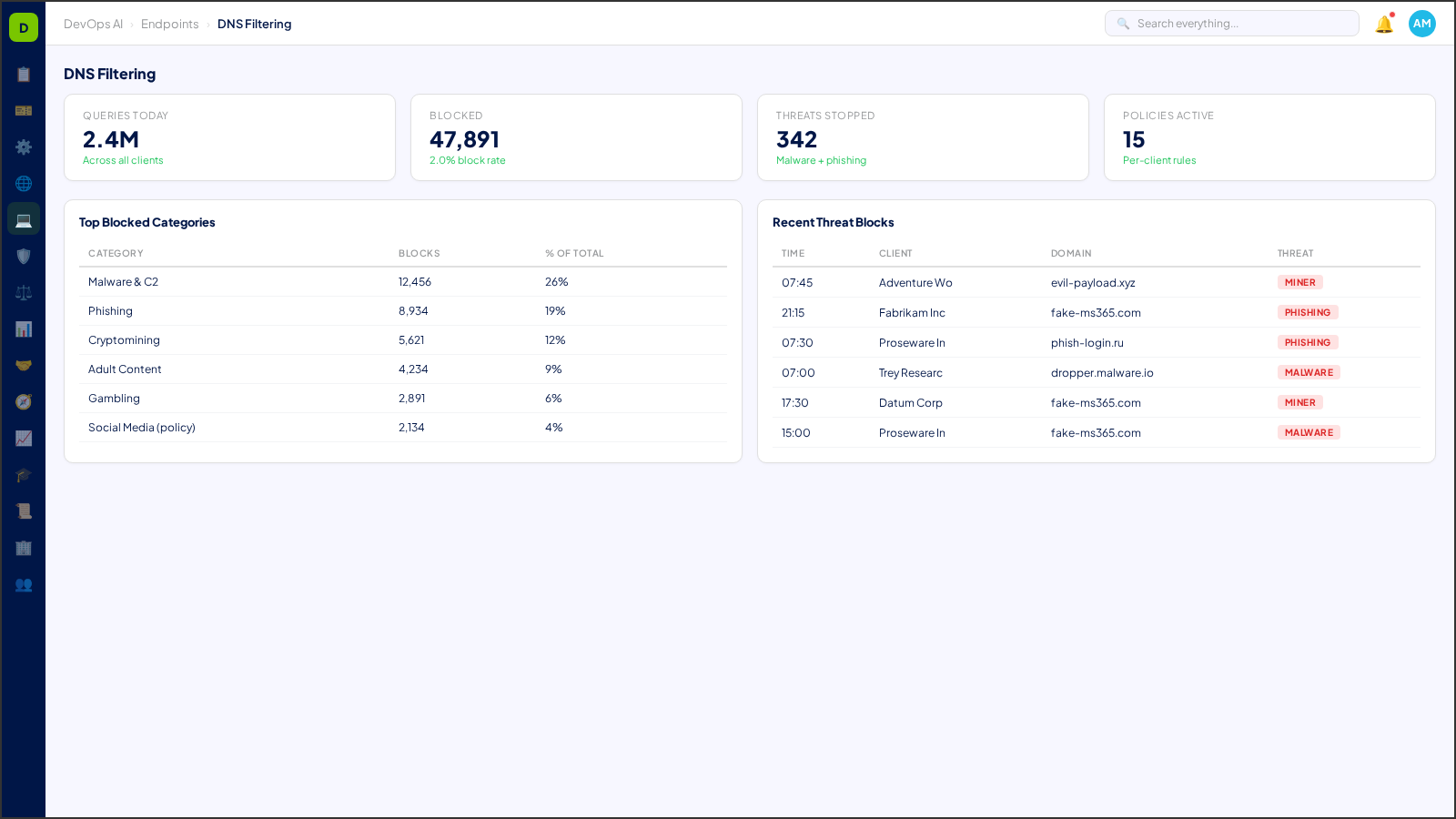
DevOps AI implements DNS Filtering as a fully integrated workflow within the Endpoint Management zone. When deployed from the Azure Marketplace, this process area is automatically provisioned with role-appropriate dashboards, notification rules, and automation policies tailored to your MSP's operational requirements.
Workflow Architecture
The DNS Filtering workflow follows DevOps AI's standard event-driven architecture. Events are ingested through the platform's connector framework — pulling data from PSA tools (ConnectWise, Datto Autotask, HaloPSA), RMM platforms (NinjaRMM, Datto RMM), and Microsoft 365 tenants — then processed through the AI inference pipeline before reaching the L1 gate for human review.
Multi-Tenant Isolation
Every operation within DNS Filtering respects DevOps AI's zero-trust multi-tenant architecture. Client data is isolated at the Azure tenant level, encrypted at rest with customer-managed keys, and processed within geo-fenced compute boundaries. No cross-client data leakage is possible — even AI models are trained on anonymized, aggregated patterns rather than raw client data.
Gate Level L1: Notify
DNS Filtering is classified at HITL Gate Level L1, which defines exactly when AI acts autonomously and when human judgment is required. This classification was determined through risk analysis of the process area's blast radius, reversibility, and compliance implications.
AI executes autonomously with full logging. No human approval needed.
AI executes and notifies the assigned human for review.
AI prepares and recommends; human must approve before execution.
Humans perform the action with AI decision support only.
Why L1?
This process area involves moderate-risk operations where AI accuracy is high but human awareness is important. The notify-and-review model allows AI to maintain operational velocity while ensuring humans stay informed and can intervene when edge cases arise.
Platform Integration
DNS Filtering does not exist in isolation — it integrates with other process areas across the Endpoint Management zone and the broader DevOps AI platform through the event mesh architecture. Actions in this process area can trigger workflows in related zones, and events from other zones can feed into DNS Filtering operations.
Connector Framework
DevOps AI's connector framework provides bi-directional integration with the tools MSPs already use. For DNS Filtering, this typically includes PSA platforms (ConnectWise Manage, Datto Autotask, HaloPSA), Microsoft Graph API (Azure AD, Intune, Defender), and specialized third-party tools relevant to Endpoint Management operations. All connectors are managed through the platform's Marketplace zone — install once, available everywhere.
Analytics & Reporting
Every operation within DNS Filtering generates structured telemetry that feeds into the Analytics zone. Dashboards provide real-time visibility into process area health, throughput, error rates, and HITL override frequency. Over time, the AI models learn from human overrides to improve future recommendations — creating a continuous improvement loop that makes DNS Filtering more accurate with every interaction.
Audit Trail
Complete audit provenance is maintained for every action within DNS Filtering. This includes the triggering event, AI analysis results, HITL gate decisions (including who approved and when), execution outcomes, and any rollback actions. Audit data is immutable, tamper-evident, and exportable in OSCAL format for compliance evidence collection.
All Process Areas in Endpoint Management
Explore other process areas within the Endpoint Management zone.